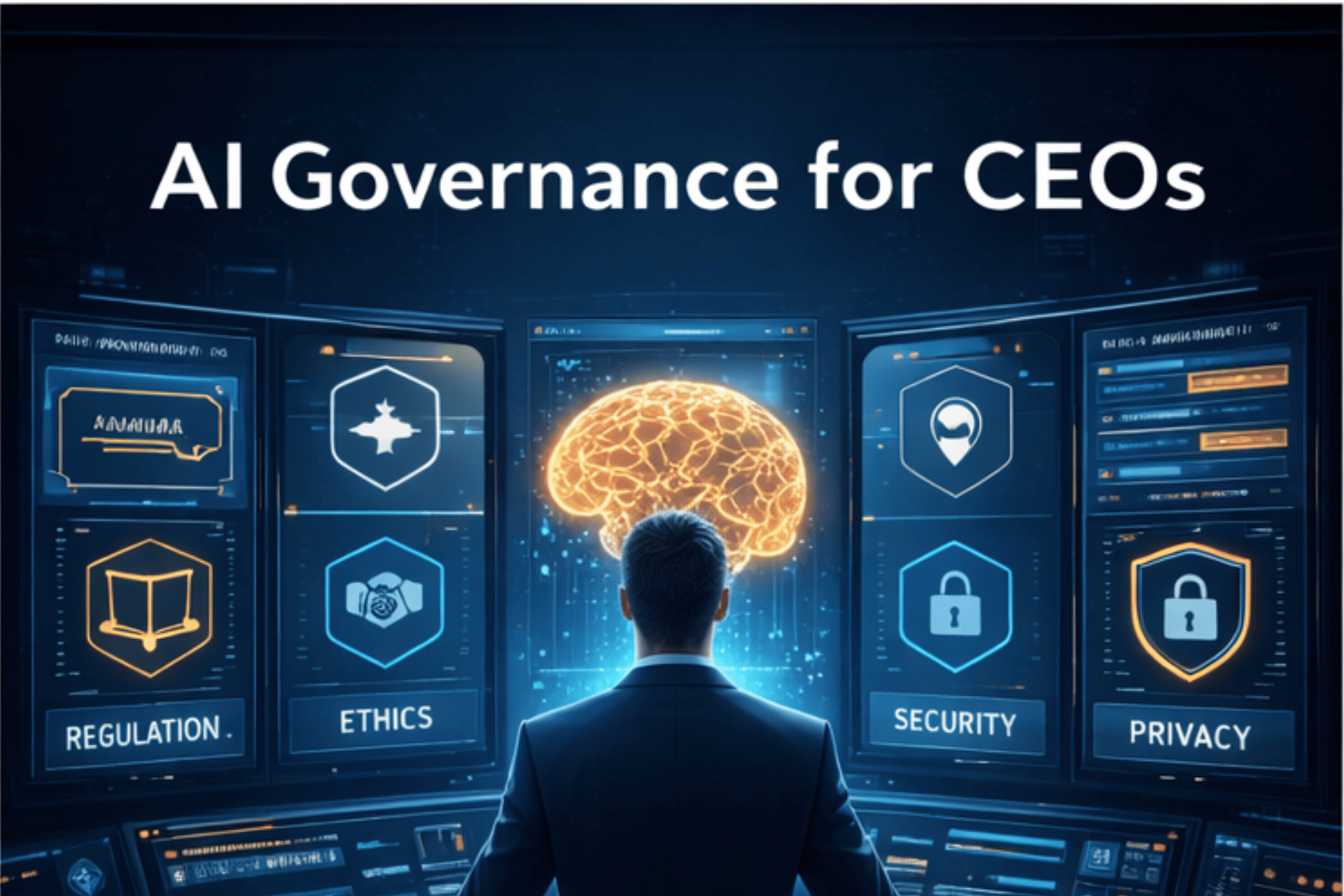
The CEO’s relationship with AI governance is often framed as a technology question. This is the wrong frame. AI governance is a decision and accountability question — and most organisations are not currently equipped to answer it.
What Governance Means in Practice
AI governance is not a compliance checklist. It is a structured set of mechanisms that ensure an AI initiative remains within defined boundaries throughout its lifecycle. In practice, effective AI governance requires four elements: clear decision gates, escalation authority, scope discipline, and risk governance.
Decision Gates
Decision gates are defined points in the project lifecycle where an explicit decision is required to proceed. These are not status updates. They are moments where someone with appropriate authority must actively decide to continue. The default in most AI initiatives is passive continuation — no one decides to go forward, things simply move forward. Decision gates invert this default. Continuation requires an active decision. Stopping is the default.
For a CEO, this matters because decision gates are the moments where executive accountability is exercised. A governance structure without decision gates is a governance structure without accountability. The project moves forward, costs accumulate, and no individual can be identified as having made the decision that led to the outcome.
Escalation Authority
Escalation authority is a defined person or function with the authority to stop, redirect, or escalate the initiative. This is different from project oversight. A project manager monitors progress. Escalation authority can halt it. In most AI initiatives, this authority either does not exist, or it is formally assigned but practically unused.
The test of whether escalation authority is real is simple: has it ever been used? If an initiative has never been stopped, redirected, or escalated despite encountering problems, the escalation authority is nominal. For a CEO, the question to ask is who specifically has the authority to stop this project, and when did they last exercise that authority on something similar.
Scope Discipline
Scope discipline is the ongoing enforcement of the boundary between what the initiative is supposed to deliver and what it has been asked to deliver over time. AI initiatives are particularly vulnerable to scope expansion because the technology appears capable of addressing many problems simultaneously. Vendors may encourage this — broader scope typically means larger contracts.
Effective scope discipline requires a documented baseline scope, a formal process for evaluating scope changes, and the authority to refuse scope additions that compromise the core delivery. Without this, the initiative gradually expands to fill available budget, and the original business case becomes impossible to validate.
Risk Governance
Risk governance in AI initiatives is not the same as general project risk management. It includes the specific risks associated with AI systems: model behaviour risk, data quality risk, integration risk, and adoption risk. Each of these can compromise the value of an initiative even when the technical delivery is successful.
From a CEO’s perspective, the key risk governance question is not what could go wrong during implementation — it is what happens if the AI system behaves in ways that were not anticipated after deployment. The governance structure must include mechanisms for identifying this, escalating it, and responding to it. Most AI governance frameworks stop before deployment. The ones that matter extend beyond it.
What CEOs Should Sign Off On — and What They Should Not
A CEO should sign off on the business case, the governance structure, and the escalation authority. These are executive decisions. A CEO should not sign off on vendor selection criteria, model architecture decisions, or implementation timelines — these are technical decisions that require technical review. The failure mode in most organisations is the inverse: CEOs are asked to approve technical decisions they cannot evaluate, while governance structures — which they could and should influence — are left to project teams.
The question to ask before signing off is not whether the initiative is technically sound. It is whether the organisation has the governance infrastructure to detect and respond when it is not.