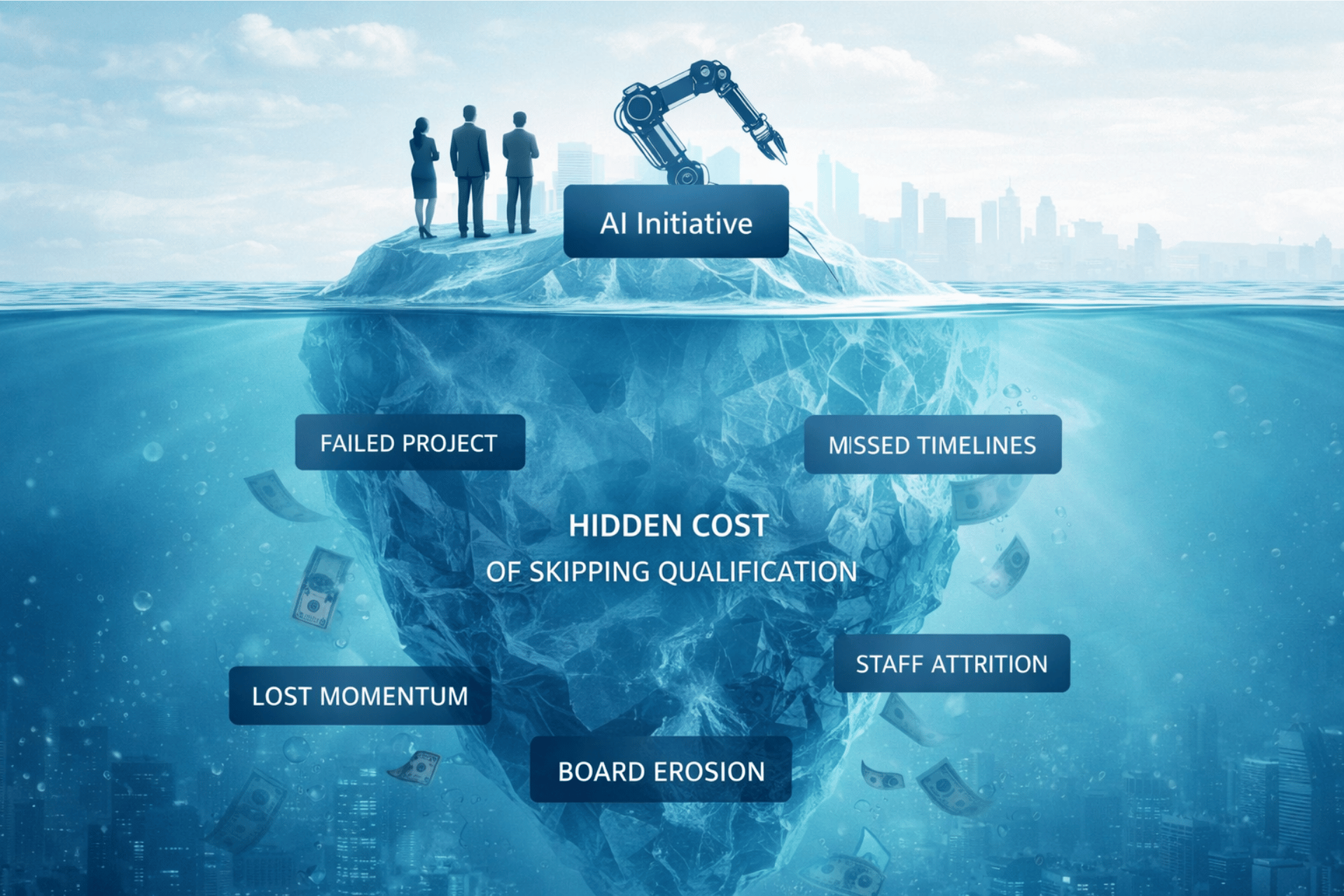
When organisations skip AI qualification, the immediate cost appears manageable. A project starts, a vendor is engaged, timelines are set. The real cost only becomes visible later — and by then, it is rarely attributed correctly.
Capital Waste
The most visible cost of insufficient qualification is financial. AI initiatives without structured problem definition consistently overrun budgets. This is not primarily because AI is expensive — it is because the scope was never properly defined. Vendors price against a scope. If the scope is vague or incorrect, the project expands to fill the ambiguity, and the client absorbs the cost.
In most cases, the capital waste is compounded by the cost of remediation: rearchitecting a solution built on the wrong assumptions, retraining a model on poorly specified data, or rebuilding stakeholder trust after a failed delivery. These costs dwarf the original project budget. The remediation is also slower and harder to staff — no vendor is enthusiastic about fixing another vendor’s failed scope.
Reputational Risk
Beyond the financial cost, there is a reputational consequence that is harder to quantify but more damaging to the organisation’s long-term AI capacity. A failed AI initiative does not just waste the capital invested in that initiative. It raises the internal cost of approving the next one. webmasterards that have approved a failed AI project are substantially more cautious about the next proposal — and that caution is not always applied with the discrimination needed to distinguish a poorly structured initiative from a well-structured one.
The reputational risk extends externally as well. Clients, partners, and regulators increasingly scrutinise how organisations deploy AI. A failed or poorly governed AI initiative is not a private matter. It leaves artefacts — discontinued systems, failed integrations, data handling questions — that become visible over time.
Opportunity Cost
Every failed AI initiative consumes internal capacity that could have been directed elsewhere. The executive time spent managing a failing project, the engineering hours invested in a misdirected integration, the board attention spent reviewing problems — these are not recoverable. The opportunity cost is not just the capital spent. It is the initiatives that were not pursued because this one consumed the available resources.
This is particularly significant in competitive environments where AI capability is genuinely differentiating. An organisation that wastes twelve months on a failed initiative may have permanently ceded ground to a competitor that used the same twelve months to deploy a working system.
What AI Qualification Actually Involves
AI qualification is not a prolonged academic exercise. It is a structured process that answers four questions before any commitment is made: Is the problem well-defined and measurable? Is the data available, accessible, and of sufficient quality? Is the organisation ready to absorb and operate the solution? Is the expected return defensible against a structured cost model?
None of these questions require significant time to answer if the right expertise is applied. A structured qualification engagement typically takes four to six weeks. The output is a documented business case with stated assumptions, a risk register, and a go/no-go recommendation. The recommendation may be to proceed, to proceed with modifications, or to not proceed. All three outcomes are valuable. Only one of them — proceed — leads to implementation expenditure.
The False Economy of Speed
The argument most commonly made against structured qualification is speed. There is competitive pressure to deploy AI. Markets move quickly. The organisation cannot afford to spend six weeks on qualification when it needs to move.
This argument has surface plausibility and is almost always wrong. The speed lost in qualification is measured in weeks. The speed lost in recovering from a failed, unqualified initiative is measured in months to years. The organisations that move fastest in AI are not the ones that skip qualification — they are the ones that qualify rapidly and accurately, so that when they commit, they commit to the right things.