The term “AI advisory” has become so broadly applied that it has lost most of its meaning. It describes everything from vendor resellers to independent governance consultants. It is used by firms that earn commissions on implementation contracts and by firms that are structurally prohibited from doing so. Understanding the difference matters — because the difference determines whether the advice you receive is actually independent.
What Independent AI Decision Assurance Actually Means
Independent AI decision assurance is a structured process designed to answer one question before commitment: is the decision to proceed with this specific AI initiative defensible?
Defensibility is the operative word. A defensible decision is one that can be explained to a board, justified to an audit committee, and revisited without embarrassment if things go wrong. It is based on evidence, structured analysis, and independent verification — not on vendor promises, internal enthusiasm, or competitive pressure.
The Independence Test
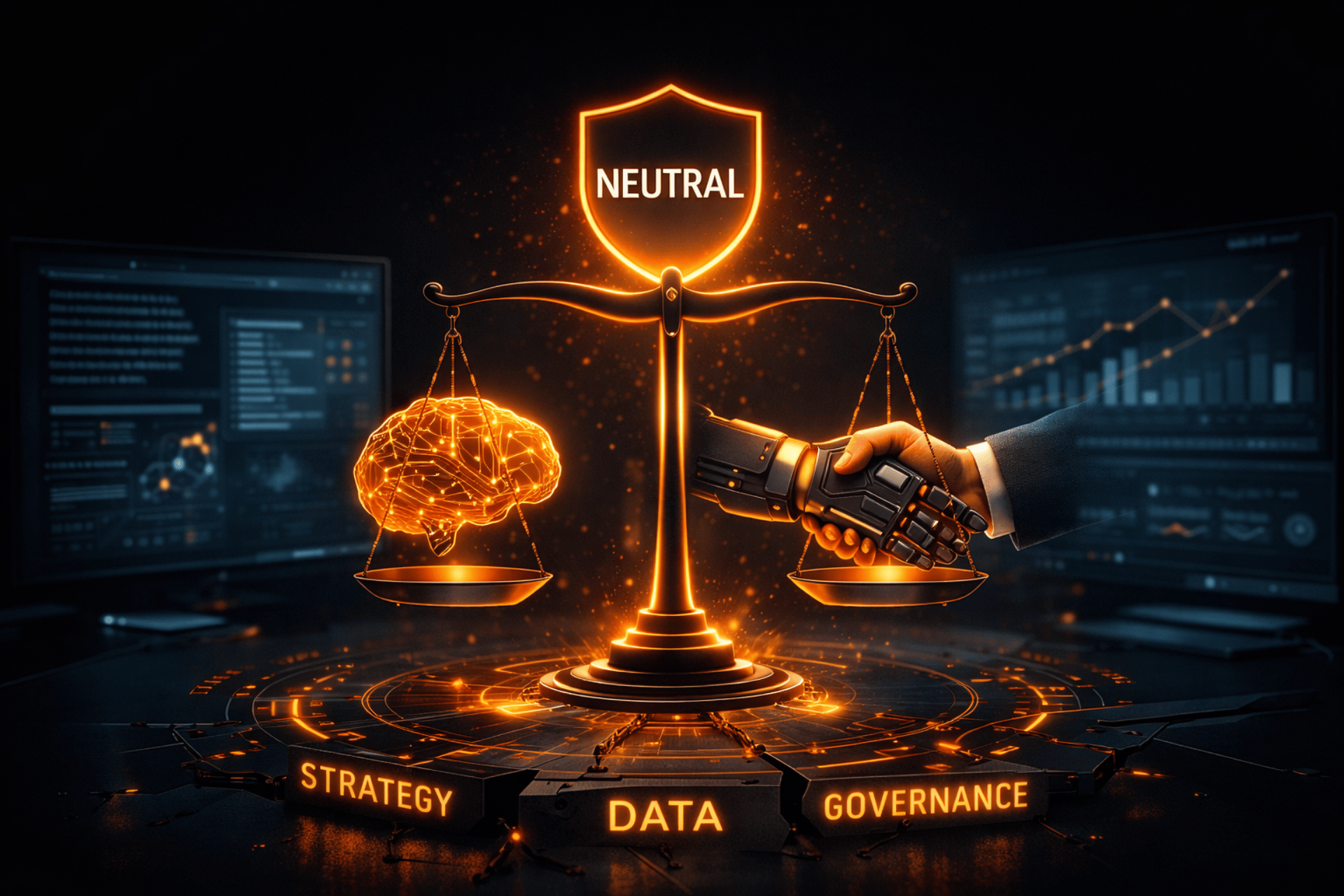
Independence is not a posture. It is a structural condition. An advisor is independent if, and only if, their compensation is not affected by which vendor is selected, whether the project proceeds, or what the implementation cost is. If any of these conditions do not hold, the advisor is not independent — regardless of what they call themselves.
This has practical implications. A firm that earns implementation fees, referral fees, or ongoing managed service revenue from AI vendor relationships cannot provide independent decision assurance for those relationships. A firm whose revenue grows when projects are approved cannot provide independent qualification services. The structure of the relationship determines the quality of the independence — not the reputation of the firm or the seniority of the individual.
What the Process Looks Like
Independent AI decision assurance follows a defined methodology. The first phase is problem definition: articulating precisely what problem the AI initiative is intended to solve, in terms specific enough to be measured. Vague problem statements — “improve efficiency”, “enhance customer experience” — cannot be evaluated. They need to be converted into specific, measurable conditions that the AI system will either meet or not.
The second phase is evidence review: examining the data, technical infrastructure, and organisational capacity that the initiative depends on. AI systems are only as good as the data they process and the organisations that operate them. Evidence review identifies the gaps between what exists and what is required.
The third phase is vendor assessment: evaluating whether the proposed vendor has the demonstrated capability to deliver what they have proposed. This is not a request for proposal evaluation — it is independent verification of whether the vendor’s track record, methodology, and team are consistent with their proposal. Many vendors are excellent at writing proposals. Fewer are excellent at delivering what the proposals describe.
The fourth phase is the decision recommendation: a documented assessment of whether the initiative should proceed, with what modifications, or not at all. This is not a consensus document. It is a professional judgment, with stated assumptions, stated risks, and a stated position.
What It Is Not
Independent AI decision assurance is not project management. It does not manage the implementation. It does not continue indefinitely. It is a bounded engagement with a defined output — a documented, defensible recommendation on whether and how to proceed.
It is also not AI strategy. AI strategy addresses the long-term role of AI in the organisation’s competitive position. Decision assurance addresses a specific initiative at a specific decision point. The two are related but distinct. An organisation may have a clear AI strategy and still require independent decision assurance on each initiative — because strategy sets direction, but assurance determines whether each specific commitment is justified.
Why It Matters Now
AI investment is accelerating. The pressure to deploy AI — from boards, from competitors, from vendors — is at a level not seen in previous technology cycles. In this environment, the risk of committing to the wrong initiative, the wrong vendor, or the wrong scope is higher than at any previous point. The organisations that will benefit most from AI are not the ones that move fastest. They are the ones that make the fewest irreversible mistakes. Independent decision assurance is the mechanism that reduces the probability of those mistakes.